
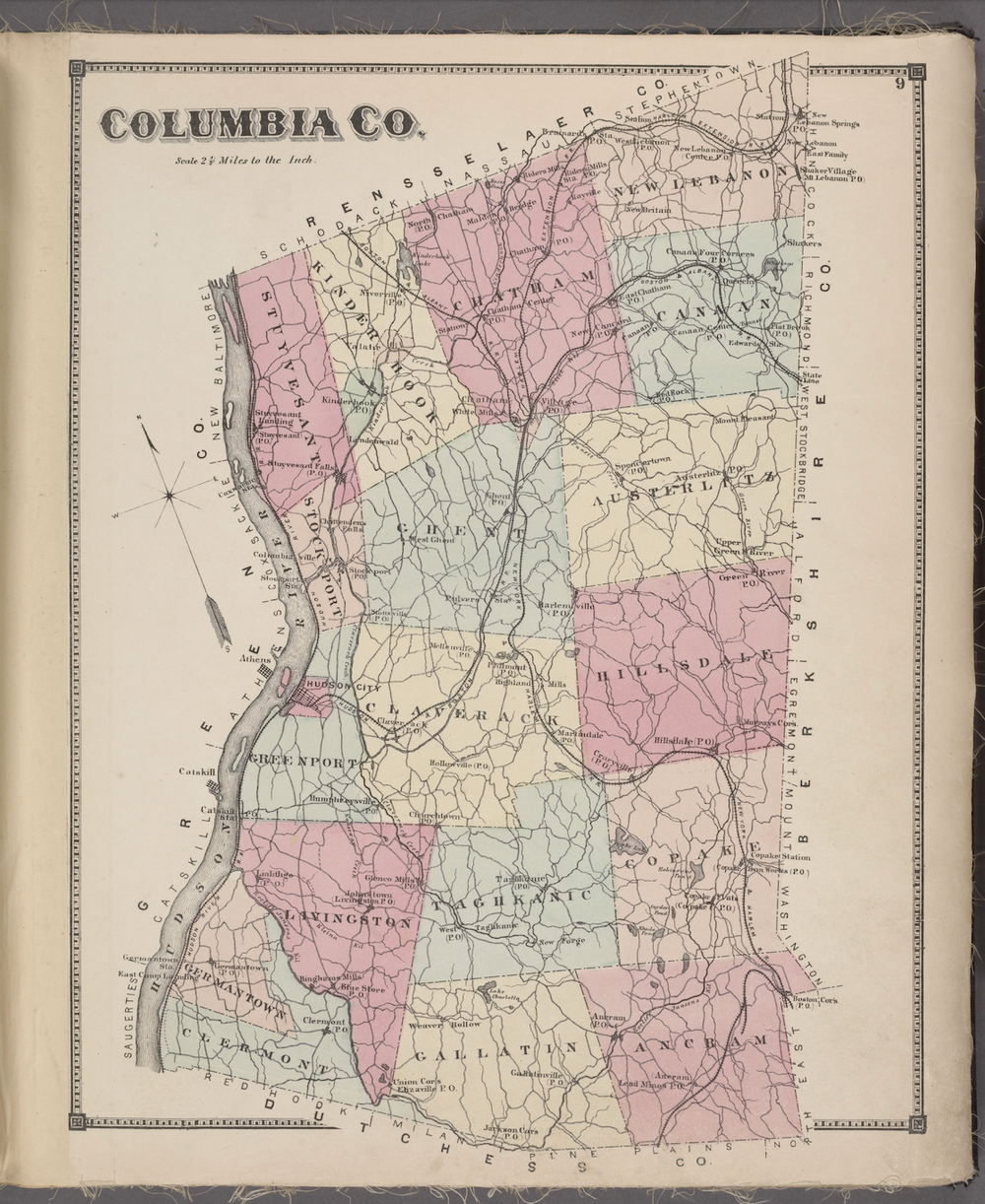
1632
The first land patent, 600 acres, in Columbia County was issued to Major Abraham Staats, one of the earliest immigrants to America.

Presented By

Margot Becker is an artist, weaver, and educator based in Hudson, NY. Through tactile processes, she explores the sense of place, natural environment, and the connection between the individual and the communal subconscious. Using the inherent restrictions of the woven grid, her forms are inspired by organic shapes that reflect the interconnectedness of human and non-human structures. Her work spans complex loom weavings, performance pieces, and site-specific sculptures. Delving into the mirroring of internal physical and mental structures with botanical forms, Becker seeks to visualize the impact an individual can have on the world. Her work has been exhibited in New York, San Francisco, Los Angeles, Chicago, and Houston. She has attended residencies at the Houston Center for Contemporary Craft, ACRE, Mildred’s Lane, Rabbit Island, and AZ West. Becker received her BA in Studio Art from Bard College in 2009 and her MFA from California College of the Arts in 2020, where she was awarded the Edwin Anthony & Adelaine Boudreaux Cadogan Scholarship and the Toni A. Lowenthal Memorial Scholarship for Excellence in Textiles.

Trenton Duerksen is a New York-based artist with a career spanning twenty-eight years in the city. He graduated from The Cooper Union in 2001. Duerksen’s practice is centered in sculpture, though a rigorous drawing practice remains a cornerstone of his daily work.
His work has been featured in significant exhibitions, including MoMA PS1’s Greater New York series, Galerie Emmanuel Perrotin, Rivington Arms, and Socrates Sculpture Park. He has been represented by Guild & Greyshkul in New York and Galerie Parisa Kind in Frankfurt, Germany. Beyond traditional galleries, Duerksen served as the artist-in-residence for the final five issues of Nest Magazine: A Quarterly of Interiors.
Duerksen's artistic perspective is profoundly shaped by his decade-long role as Senior Exhibition Maintenance Manager at the American Museum of Natural History. Maintaining a studio within the museum, his work often explores the intersection of scientific inquiry and the material legacy of past civilizations. His contemporary sculptural practice, which balances a dichotomy of serious craftsmanship and humor, draws on the material history of objects and the evolution of craft. This work is further informed by his personal history, speaking to the universal themes of the human experience and the subtle, often humorous, moments of everyday life, built on the foundation of being raised a Mennonite in Kansas.

Daniele Frazier is a New York-based artist, published writer, and educator dedicated to a practice marked by rigorous formal aesthetics and a profound engagement with materiality. Her conceptually rich work balances a deep investment in craft with serious inquiry into phenomenology, the texture of everyday life, and the politics embedded within public space and the definition of ownership. Frazier employs a diverse material vocabulary influenced by a passion for collecting—from metalwork and textiles to alternative camera-less photographic and darkroom processes.
Frazier's work has been exhibited widely at institutions and galleries including the Whitney Museum, The Queens Museum, Socrates Sculpture Park, Guild & Greyshkul, Museum 52, Rivington Arms, Ritter Zamet, and Gavin Brown’s Passerby, among others. With 10 years of experience creating public sculpture in NYC, she brings her materially informed artistic life into direct dialogue with the social and political landscape of the city. She further extends this commitment to public memory, craft, and social practice through her work for the NY AIDS Memorial, where she facilitates the creation of new panels for the AIDS Quilt.
As an educator, she lectures at numerous colleges and currently instructs at the Buxton School. As a published writer and experienced speaker, she merges her studio insights with scholarship. Having served for over a decade on the Cooper Union admissions committee, Frazier offers a rare and invaluable perspective on contemporary art, interdisciplinary learning, and the college admissions landscape.
Frazier's current studio practice pushes the boundaries of photographic media. She has begun to color-process photograms in order to activate expired Kodak Ektachrome paper, leading a profound exploration into optics, light, chemistry, and color theory. This experimental work exemplifies her commitment to leveraging material constraints as a basis for unprecedented artistic invention.

Eric Wolf (b. 1960, American) is a painter and designer based in New York’s Hudson Valley. He is a graduate of the Rhode Island School of Design, BFA 1982 in Photography, and the City College of New York, CUNY, MFA in Painting, 1990, and attended Skowhegan, 1989. Wolf has had residencies at Yaddo, MacDowell, Giverny, the Blue Mountain Center and Art Omi.
Solo exhibitions include: Abri Mars, Pamela Salisbury Gallery, Gregory Lind Gallery, Oresman Gallery at Smith College, The Williston School, Jeff Bailey Gallery, Fredericks-Freiser Gallery, Jessica Fredericks Gallery, and Kristina Wasserman Gallery.
Recent group exhibitions include: Upstate Art Weekend, Loading Invitational 2, Abri Mars, Hudson, NY | NADA, New York 2026, Abri Mars | Hexum Gallery Montpelier, VT | Albany International Airport Gallery, Albany, NY | Abri Mars, Hudson, NY | CR-10, Linlithgo, NY | Pamela Salisbury Gallery, Hudson, NY, | BOX, Sharon, CT | Undercroft Gallery, New York | Bernay Fine Art, Great Barrington, MA | Bill Arning Exhibitions, Kinderhook, NY | McKenzie Fine Art, New York | Private Public Gallery, Hudson, NY | The Berkshire Botanical Garden Gallery, Stockbridge, MA. | Miles McEnery Gallery, New York.
Exhibition reviews include: Artforum, by Linda Yablonsky; Two Coats of Paint, by Sharon Butler; Art Spiel, by Taylor Bielecki; Albany Times Union by Matt Moment, Hyperallergic and Chronogram by Taliesin Thomas, Artspiel, by Etty Yaniv, Visual Art Source by DeWitt Chang, The New York Times, by Roberta Smith, Holland Cotter and Ken Johnson, The New Yorker by Alexi Worth and David Rimanelli, Art News by Gregory Volk, Art in America by Vincent Katz, Artforum by Julie Caniglia.
In reimagining the barns as spaces for gathering and creativity, the architecture firm BarlisWedlick and Margie Ruddick Landscape seamlessly blended the structures’ historic past within an ethos of sustainability and environmental sensitivity, to maintain the land’s scenic beauty and ecological integrity.


These lands were once the land of the Mahican Indian tribe, an Eastern Algonquin Native American Tribe who inhabited the upper tidal Hudson River Valley. Their name reflects the original name of the Hudson River, Mahicannituck, the People of the Waters That Are Never Stil.
We are grateful to have the opportunity to live and work on these ancestral lands, and we honor and recognize the countless sacrifices made by these Native Peoples so that we may care for this beautiful place.


shaped by nature
Thoughts, musings, seasonal offerings and new products. Join us as we explore the seasonal abundance and joy of our Hudson Valley farm.